Florence: counter-planning and resistance to the extraction of private surplus value from the historical and territorial heritage
Abstract
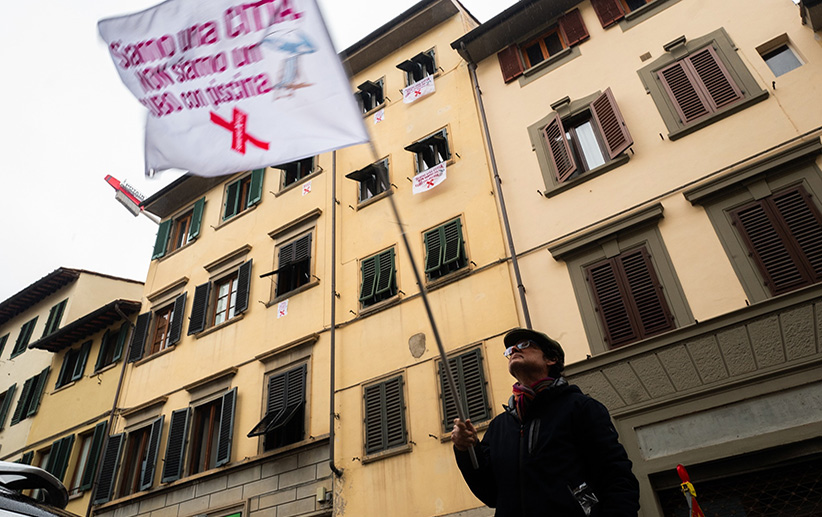
The paper analyses the process of alienation of public building heritage in historic Italian cities, interpreting it as the result of local governments' ideological adherence to the principles of global finance and tourism monoculture. Cities subject to these dynamics are defined as “alienated”: economically dependent on the extraction of surplus value from history and culture, socially emptied by the expulsion of lower-middle classes, and politically subordinate to real estate financialization. Florence, due to the quality of its territorial heritage, its historicity and the universally recognised value of its assets, is a privileged observatory. The national regulatory framework governing state-owned property has allowed authorities to sell off approximately 370,000 square metres of public buildings in the city centre, converted into tourist accommodation or luxury residential properties. This process has been facilitated by a systematic weakening of urban planning: regulatory uncertainty regarding large “transformation areas”, monetisation of planning standards, abolition of restore obligations. Finally, the paper documents civic resistance and grassroot proposals, including that for the former OGR, where movements and scholar-activists put forward the hypothesis of a public Kulturforum as a model of “major urban repair” as opposed to the extraction of private surplus value from the historic city.
Downloads
Copyright (c) 2026 Ilaria Agostini

This work is licensed under a Creative Commons Attribution 4.0 International License.
Authors who publish with this journal agree to the following terms:
- Authors retain copyright and grant the journal right of first publication with the work simultaneously licensed under a Licenza Creative Commons - Attribution 4.0 International (CC-BY 4.0) that allows others to share the work with an acknowledgement of the work's authorship and initial publication in this journal.
- Authors are able to enter into separate, additional contractual arrangements for the non-exclusive distribution of the journal's published version of the work (e.g., post it to an institutional repository or publish it in a book), with an acknowledgement of its initial publication in this journal.
- Authors are permitted and encouraged to post their work online (e.g., in institutional repositories or on their website) after the publication, as it can lead to productive exchanges, as well as earlier and greater citation of published work.